








A buffer zone created to protect Suncheon Bay becomes a “garden workation” more than a decade later
TV-free cabins, a hanok Eco Village, gukbap at Ujang Market… The city carries on after work
Suncheon’s new office sits on a garden that has kept the city from growing any farther.

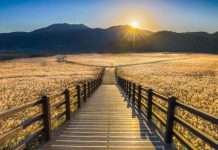
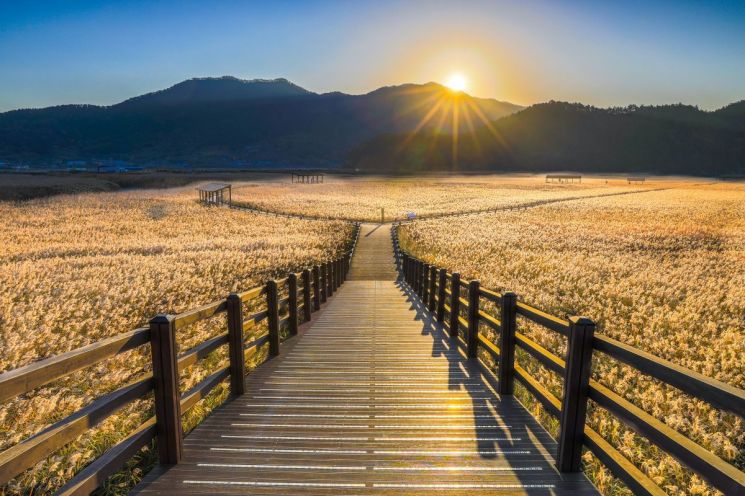
A view of the trails at Suncheonman Wetland, where golden reeds create a spectacular sight. Korea Tourism Organization
Suncheon Bay National Garden was not created for tourism. It began as an eco-belt designed to protect the natural ecosystem of Suncheon Bay and keep the city center from encroaching on the wetlands. The International Garden Expo was held there in 2013, and in 2015 it became South Korea’s first national garden. Now, more than a decade later, people are commuting to work in the heart of that garden, laptops in hand. Land where the city’s pace was slowed to protect nature has become a place people visit to work well.
That paradox becomes immediately clear when you sit in the workation center. It has glass walls on three sides. The meeting rooms, open desks, printers and portable monitors make it an ordinary office, but the view outside is anything but ordinary. The lawn is wider than the desks, and the sky is bigger than the monitors. It is less an office that has brought the garden in as a “view” than an office tucked into a vast garden.
That is why, in Suncheon, shifting gears comes more quickly than focusing. Send a few emails, open the door, and work stops. Walk along the stream, pass beneath the metasequoias, and climb Bonghwa Hill in the Lake Garden. Then return to work. In a Seoul office, saying “I’m going out for some air” usually means grabbing a cup of coffee. Here, it can mean taking a full walk around the garden.

Waterways, tidal flats and reed beds blend into a scenic landscape at dusk, viewed from above Suncheonman Wetland. Korea Tourism Organization.
Suncheon has designed this rhythm quite deliberately. The workspaces are equipped with tools for getting the job done, while the accommodations have been pared back. The cabin houses inside the national garden have refrigerators, water purifiers, shower stalls and Wi-Fi. But there are no TVs. Open the door instead, and you find a forest and a lake. Suncheon Bay Eco Village, a little farther away, consists of traditional Korean houses. You work in a glass-walled office during the day, then return beneath the eaves at night. Companies and institutions use the auditorium and multipurpose rooms, while people who come on their own have a room and a garden to themselves. The administrative terms are “shared,” “immersive” and “relational,” but the spaces themselves explain the idea far better.
The word “workation” is a little strange, really. If it’s a vacation, why work? If it’s work, why travel? Suncheon does not force the two together. Rather than cramming work and rest into one space, it puts them side by side. The difference is that there is no need to travel somewhere else after work. Once you close your laptop, you’re already at your destination. From there, Suncheon stretches beyond the garden.
Suncheon Bay National Garden covers about 280,000 pyeong. Gardens from around the world line its paths, and at the center lies the Lake Garden, designed by world-renowned landscape architect Charles Jencks. Climb the spiral-shaped Bonghwa Hill, and the garden’s contours, hidden from view below, unfold all at once. Beyond the waterways and flower beds, Suncheon’s mountains and city overlap in the distance.

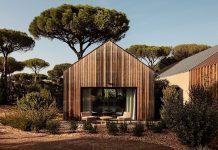
A view of the Garden Workcation cabins at Suncheonman National Garden. Photo by Kim Heeyoon
Workation participants don’t need to see the entire garden in one day. They can walk just the stream path after a morning meeting and return, then make their way to the Lake Garden the next day. Visitors have to make sure they can say “I’ve seen it” in a single day, but those who stay have tomorrow. Perhaps the real luxury of a Suncheon workation is that extra time.
The view changes again when you board the SkyCube at Garden Station. As it leaves the neatly arranged national garden and heads toward Suncheon Bay, reeds, tidal flats and winding waterways fill the view. The national garden shows how people shape nature; at Suncheon Bay, you see what remains where people have stepped back.
If you want to clear your mind even more, you can head up Jogyesan Mountain to Seonamsa Temple. As you cross Seungseongyo Bridge and walk along the old forest path, time moves in a way entirely different from the carefully designed scenery of the national garden. A garden, a wetland, a mountain temple. All are quiet, but each has its own kind of silence.

Inside the garden workation center at Suncheonman National Garden. The garden unfolds beyond the floor-to-ceiling windows. Photo by Kim Heeyoon
When hunger strikes, head into everyday Suncheon. In the gukbap alley at Ujang Market, steam rises from large pots as hands work quickly slicing pork. Some restaurants serve a plate of suyuk, or boiled pork, when you order two bowls of gukbap. Further down toward Suncheon Bay, a stew made with mudskippers caught on the tidal flats simmers with soybean paste and dried radish greens. The ecosystem you saw during the day follows you to the dinner table.
Suncheon did not set nature apart in a corner of a tourist attraction. The national garden was created to protect Suncheon Bay, and Suncheon Bay, in turn, shapes the city’s scenery and food. The traditional houses at Eco Village, the gukbap at Ujang Market and the mudskipper stew from the tidal flats may look like separate tourist offerings, but after spending a few days here, you realize they are all woven into the life of one city.
Since Suncheon launched its garden workation program in April 2024, the number of companies, institutions and participants visiting the city has continued to grow. A survey also found that most users gave high ratings to work efficiency and their willingness to return. More interesting than the numbers is the fact that this land was never originally meant to become a workplace.

A view of the area around the garden workation space at Suncheonman National Garden. Photo by Kim Heeyoon.
A place left open so the city would not spread any farther. Suncheon turned that open space into a garden, and now people make a special trip here to work in it.
Hot Picks Today

A good workation may not be a trip that makes you forget about work. It may be a city where your body is the first to realize that the workday is over. In Suncheon, the moment you close your laptop, that feeling is unmistakable.
This content was produced with the assistance of AI translation services.
© The Asia Business Daily. All rights reserved. Unauthorized AI training and use prohibited.