But the journey to the ladder turned out to be the most frightening part of the experience.
A honeymoon adventure high above a chasm
(Photo: Tsur Maoz)
“I was trying really hard to calm myself down,” she recalled in an interview with ynet. “Tsur told me, ‘Don’t look down,’ but I looked down anyway,” she said with a laugh. “I had to take my time. I’m no acrobat, and I’m not exactly in peak physical shape.”
Tsur and Chen married about a year and a half ago and embarked on a dream honeymoon that evolved into a trip around the world. By the time of the interview, they had been traveling for 16 months straight.
“I had just completed my master’s degree in psychology,” said Maoz, 29, from Holon. “I decided this was the perfect time to take an extended trip before beginning my professional training and launching my career.”
His wife, Chen Vayb, also 29, is a lawyer who decided to put her career on hold to join him.
“I finished my training, and when we get back to Israel, we’ll pick up where we left off,” she said.
Not everyone understood the couple’s decision to leave their jobs and everyday lives behind for such a long trip.
“People asked me, ‘Why would you leave your job, your apartment and your whole routine behind?’ But listen, Assaf, I saw this as a once-in-a-lifetime opportunity.”
During their travels through China, the couple arrived in the Zhangjiajie region of Hunan province and decided to tackle the famous Lingyun Sky Ladder on Qixing Mountain.
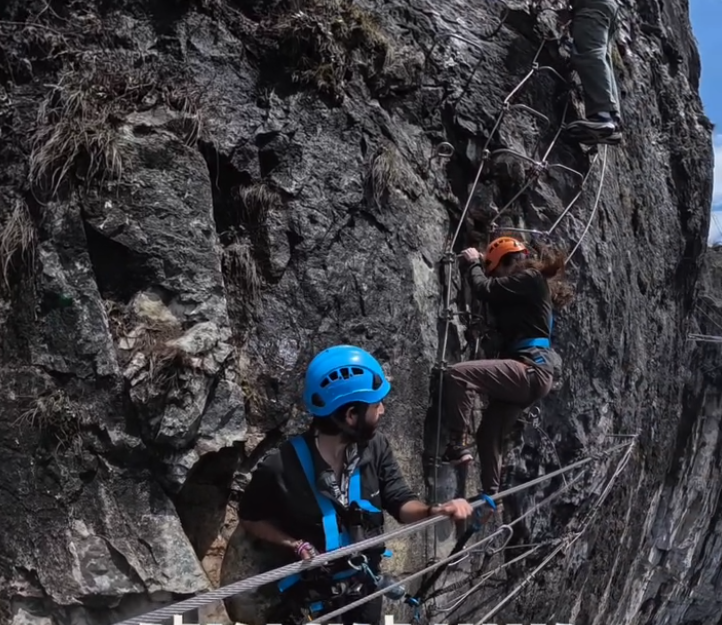
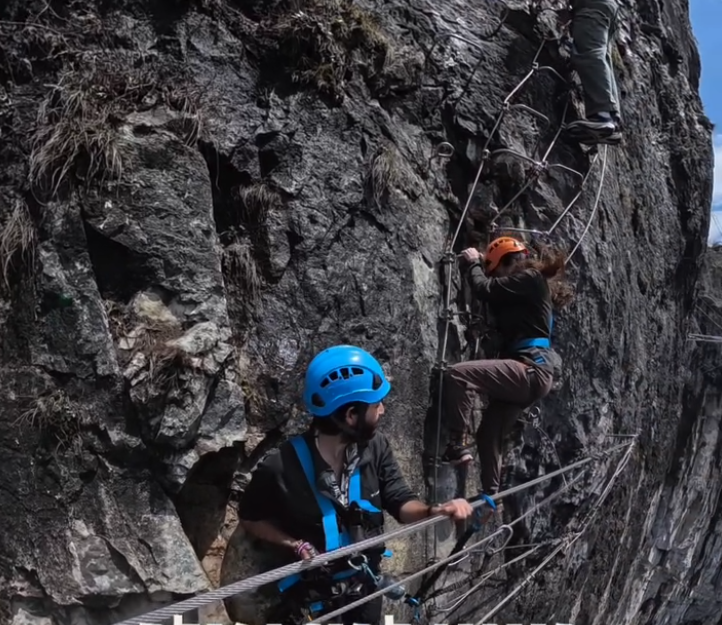
What they hadn’t expected was the terrifying journey required just to reach it. Before getting anywhere near the ladder, they had to navigate a cliffside climbing route that included walking along seemingly endless metal cables suspended high above the ground.
Chen had no idea what she was getting into.
“Somehow, the ladder itself turned out to be much less frightening than everything we had to go through to get there,” she admitted.
So how does a honeymoon end up including a hair-raising climb up a ladder stretching between two cliffs?
“I don’t know if it officially holds some kind of Guinness World Record,” Tsur said with a laugh. “But the moment I saw videos of it online, I knew I wanted to try it myself.”
Presumably, you’re not afraid of heights.
“No, I’m not afraid of heights,” he said.
Chen, on the other hand, was far less enthusiastic about the idea.
“He’d been talking about this ladder for months. And he wanted to do even scarier things, like flying through the air in one of those wingsuits. So I figured the ladder was the lesser of two evils and said, ‘Fine, let’s do it.’”
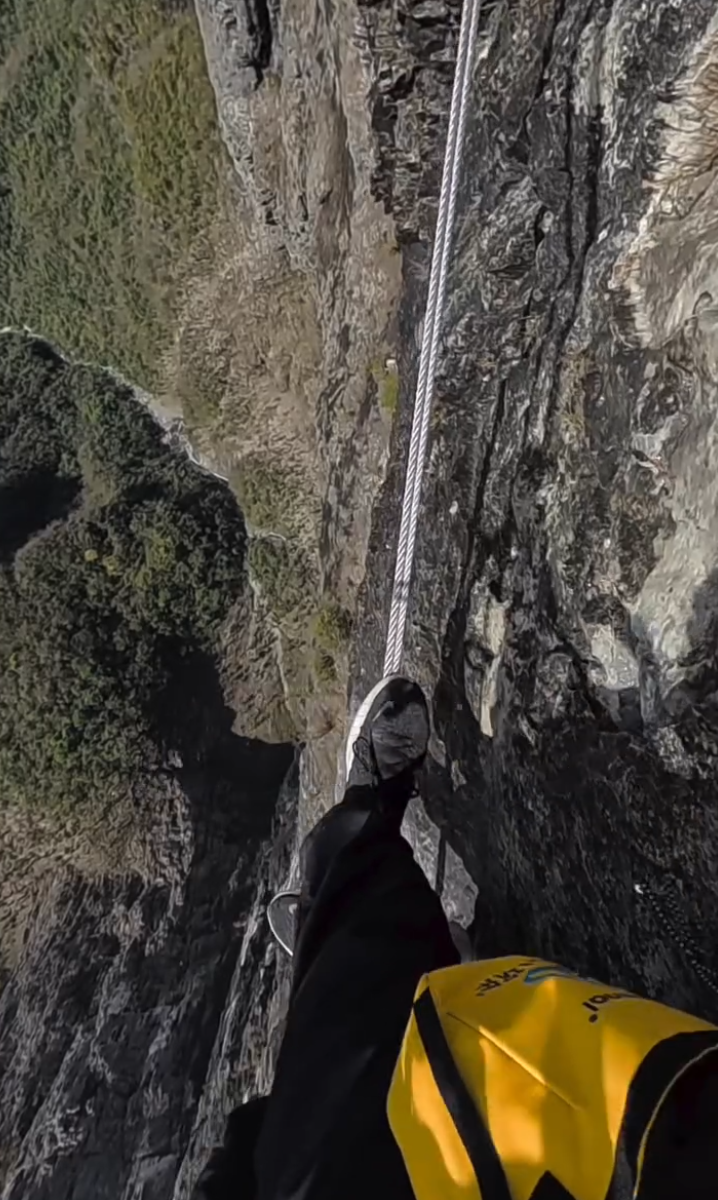
Whatever you do, don’t look down
(Photo: Tsur Maoz)
The Zhangjiajie region is known for its breathtaking mountain scenery and dramatic rock formations. One of its most famous attractions is Wulingyuan, whose towering sandstone pillars helped inspire the landscapes in the 2009 film “Avatar.”
“It’s an incredibly beautiful area, with these enormous rock pillars and mountains covered in vegetation, and mist drifting between them,” Tsur said. “There are also all kinds of adventure activities, including a superfast elevator that takes you up into the mountains and a glass bridge where you can go bungee jumping with an incredible view.”
The couple based themselves in Zhangjiajie city and spent five days exploring the surrounding area.
Tsur, who had already tried bungee jumping in Nepal, decided to skip the jump from the glass bridge this time and focus on the challenge he had come for.
“The ladder isn’t just a ladder,” he explained. “You have to complete an entire route before you even get to it. It’s more than a kilometer long, and you’re climbing along cables and making your way across the side of a mountain.”
Chen was quick to interrupt.
“Let me just say that I had no idea about that part,” she said, laughing.
The route leading to the Lingyun Sky Ladder is a via ferrata, a type of climbing route fitted with metal rungs and safety cables anchored into the rock. Climbers wear harnesses and attach themselves to the safety system, but must make their way along the course on their own.
“To be fair, I didn’t know about that part either,” Tsur admitted. “We signed some forms, they handed us helmets and harnesses, and off we went. Only once we started did we realize we were actually going to be climbing along the side of a mountain.”
He described the experience with obvious excitement.
“There are cables you have to walk on. You’re literally balancing on a thin metal wire, and that was the hardest part of the entire route.”
Even Tsur, who insists he has no fear of heights, found himself unnerved at times.
“I ended up really enjoying it, but there were moments when I looked down and got dizzy. There was another guy with us who was afraid of heights, and for him, the whole thing was an absolute nightmare.”
“There’s no guide accompanying you,” Tsur explained. “It’s genuinely frightening and pretty extreme. The safety briefing was in Chinese, so I’m not even sure I understood everything. After that, you’re basically on your own, making your way along the route while attached to a cable.”
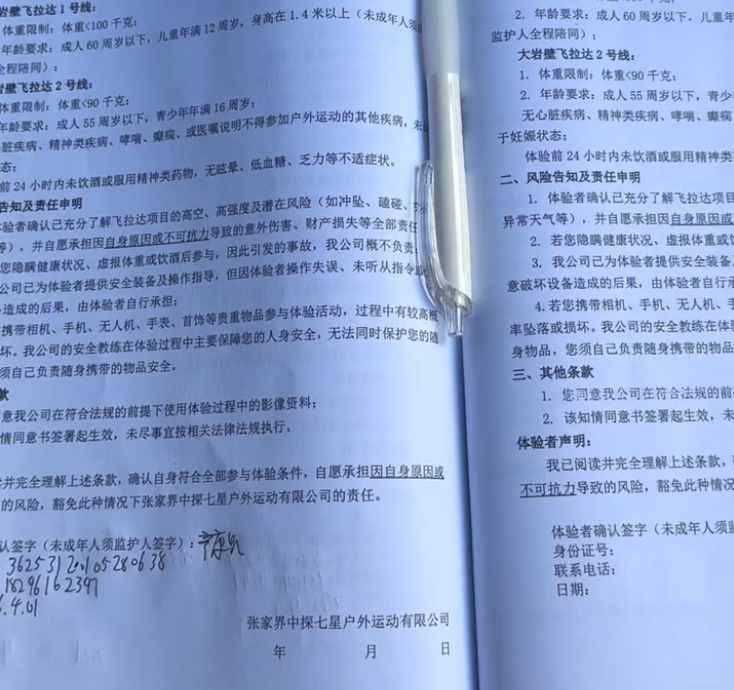
Would you sign it?
(Photo: Tsur Maoz)
Chen said it was difficult to convey just how frightening the experience had been.
“On the via ferrata, there are sections where you descend using metal railings, and then there’s a part where you’re walking on a wire above a chasm, with another cable attached to your harness. And that’s it,” she said.
“Dizziness doesn’t even begin to describe it. I was so focused on just getting through it. Those were some really stressful moments,” she added, laughing now at the memory.
For Tsur, the spectacular scenery made the experience even more surreal.
“Some people reach the ladder when it’s foggy, but we had amazing weather,” he said. “There was lush forest far below us and towering cliffs all around. The scenery was absolutely breathtaking. You feel like you’re hanging between heaven and earth, balancing on a cable. It’s an incredibly surreal experience.”
As if the heights weren’t enough, Chen also had to contend with the language barrier.
As a lawyer accustomed to carefully reading documents before signing them, she found the registration process particularly unsettling.
“They gave us all these forms to sign, liability waivers and things like that,” she recalled. “I’m a lawyer, so normally, whenever we get documents like that, I read every word. But suddenly they’re handing me forms in Chinese, and there’s no time to go through anything. It’s just, ‘Come on, let’s go!’”
The safety briefing wasn’t much easier to follow.
“The instructor was explaining how to use the carabiners in Chinese,” she said. “Then he spotted a woman he thought was Chinese. She was actually American and only spoke a little Chinese because of her parents. So he said, ‘Great, you can translate for me,’ and expected the entire group to understand his instructions through someone who barely spoke the language herself.”
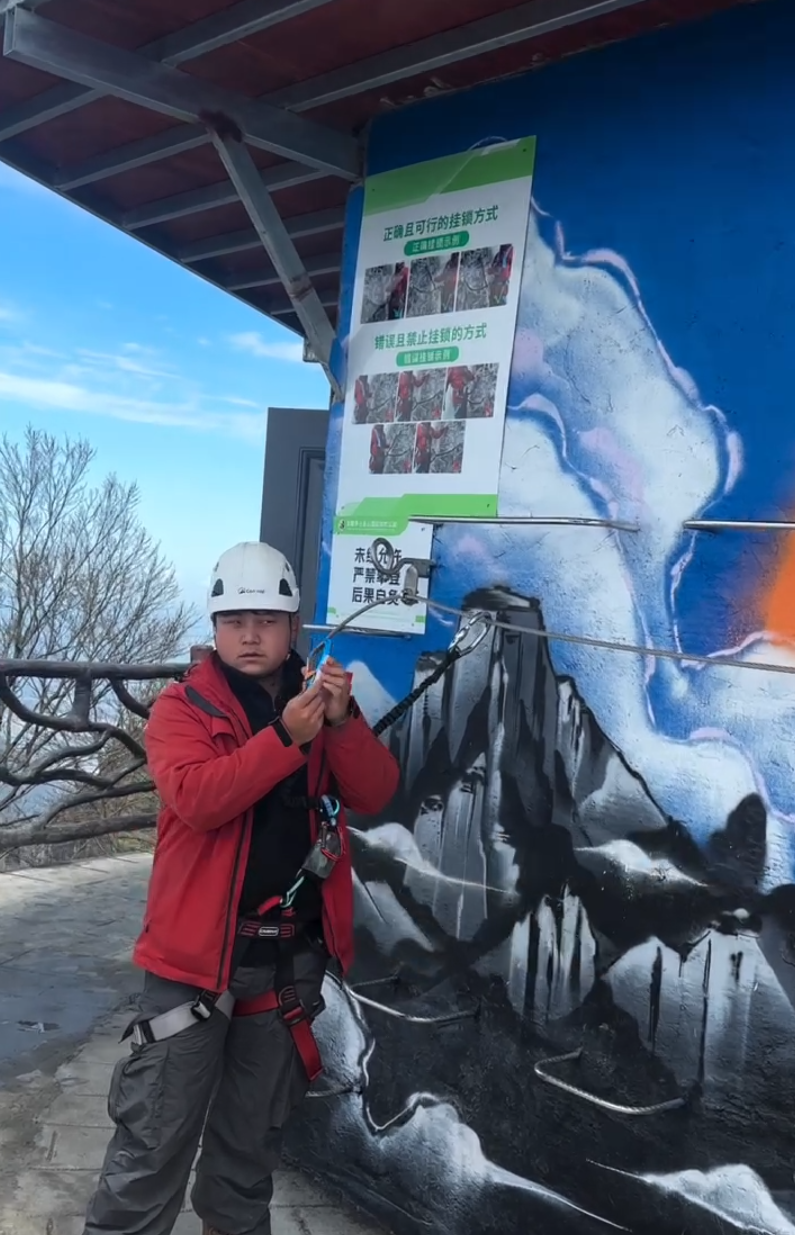
The safety briefing
(Photo: Tsur Maoz)
After completing the exhausting climb along the mountainside, the couple finally reached the ladder itself.
Stretching 168 meters (551 feet) at a 51-degree angle, the Lingyun Sky Ladder rises to an elevation of approximately 1,480 meters (4,856 feet) above sea level.
“It’s like looking up at a skyscraper and realizing you’re about to climb it,” Tsur said.
“We started climbing, and after everything we’d been through on the via ferrata, I was already running on adrenaline. Then, halfway up the ladder, the wind picked up and started swaying us from side to side.”
Chen remembers those moments all too well.
“You actually have to look down because you need to see where you’re putting your feet,” she explained.
What went through your mind when the wind started blowing?
“It wasn’t a great feeling,” she admitted. “You start feeling the ladder shake, and you can actually see it moving. You have to keep stopping, assessing the situation and making sure everything is OK before taking another step.”
Tsur tried to manage the fear by concentrating on the task immediately in front of him.
“I focused on my breathing,” he said. “You have to think about your next step instead of what’s beneath you. The goal is just to make it through the next section, not to think about the entire climb or start imagining what could go wrong.”
Breaking the challenge down into smaller steps helped him stay calm.
“When you take it one step at a time, I think you can block out the fact that you’re so incredibly high up and basically hanging in midair.”
Chen came up with a different coping strategy: music.
“I started singing ‘Stayin’ Alive’ by the Bee Gees,” she said. “It helped me focus, keep my eyes open and try not to look down, although that was really hard.”
And what did your parents think when they found out about the climb?
“My mother didn’t even know we’d done it until she saw the video on Instagram,” Tsur said with a laugh.
“I think the Sky Ladder is best suited for young couples who aren’t too pampered.”
The entire experience takes about three hours and costs 780 yuan (approximately $117 or 390 shekels) per person. The price includes park admission, round-trip cable car transportation, shuttle rides, climbing equipment and a safety briefing.
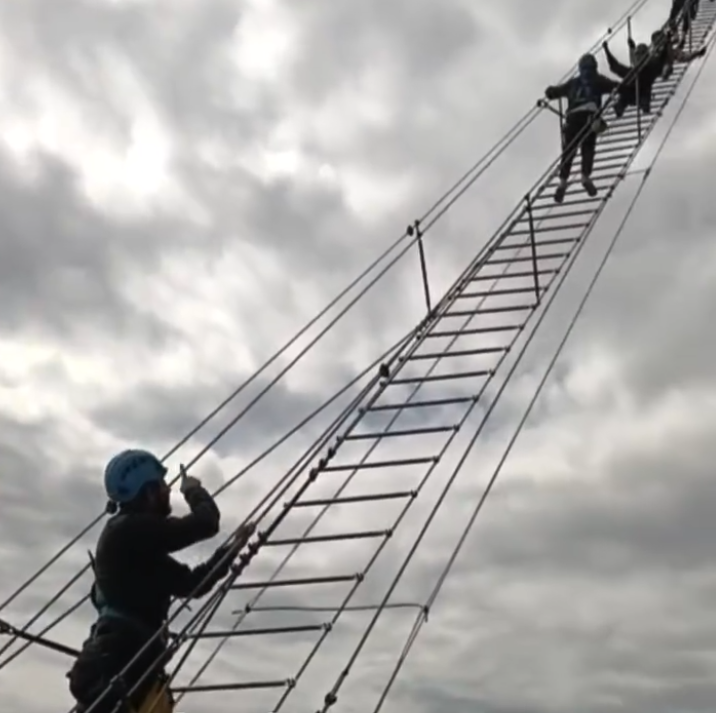
Finally, the ladder comes into view
(Photo: Tsur Maoz)
The bridge stretches 430 meters (1,411 feet) across a canyon, with a transparent glass floor that allows visitors to look straight down into the chasm below.
Tsur, however, wasn’t quite as impressed by the bridge as he had expected.
“The glass was pretty cloudy, so it was hard to see what was underneath,” he said. “But there’s also a really beautiful nature trail with a wooden walkway that passes beneath waterfalls, and there are boats too. It’s basically a kind of amusement park with some mildly extreme attractions, but it’s suitable for families.”
The Sky Ladder and glass bridge were just two highlights of the couple’s adventures in China.
But beyond the stunning scenery and adrenaline-fueled attractions, traveling through the country presented some unexpected challenges, particularly when it came to communication.
“It’s difficult to get by in English,” Chen said. “You really need translation apps, and a lot of the apps we’re used to, like WhatsApp, Facebook and Instagram, are blocked there.”
Tsur had another practical tip for travelers.
“You should install a VPN before entering China so you can get around the restrictions,” he advised. “It’s known as the Great Firewall of China. Even staying in touch with the outside world can be a challenge when you’re traveling there.”
Despite the difficulties and the language barrier, the couple wholeheartedly recommends China as a destination for Israeli travelers.
“Of all the countries we’ve visited, China has been one of the biggest surprises,” Tsur said.
“It’s an incredibly modern, developed country with endless attractions, fantastic domestic tourism infrastructure and a very high level of safety. And I don’t think Israelis have really discovered it yet.”