







Posted November 13, 2026 | By Staci Biondini, Special to the ‘Ocala Gazette’ / Photos courtesy Biondini family
This year, Route 66 celebrates its 100th anniversary. Few highways have captured the American imagination quite like the Mother Road, a symbol of freedom, adventure and nostalgia for a time when the journey mattered as much as the destination.
Established on Nov. 11, 1926, Route 66 connected Chicago, Illinois, with Los Angeles, California, and eventually extended to Santa Monica. During the Dust Bowl of the 1930s, thousands of families fleeing drought and economic hardship traveled west along the highway in search of a better life. By 1938, Route 66 was fully paved and its popularity soared after World War II as affordable automobiles and rising incomes inspired Americans to explore the country by car.
My family first experienced the Mother Road in 2020, driving from its Chicago starting point near Lake Shore Drive to St. Louis, Missouri, where we visited the Gateway Arch and indulged in frozen custard at the legendary Ted Drewes.

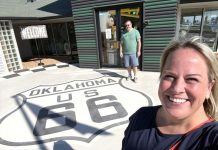
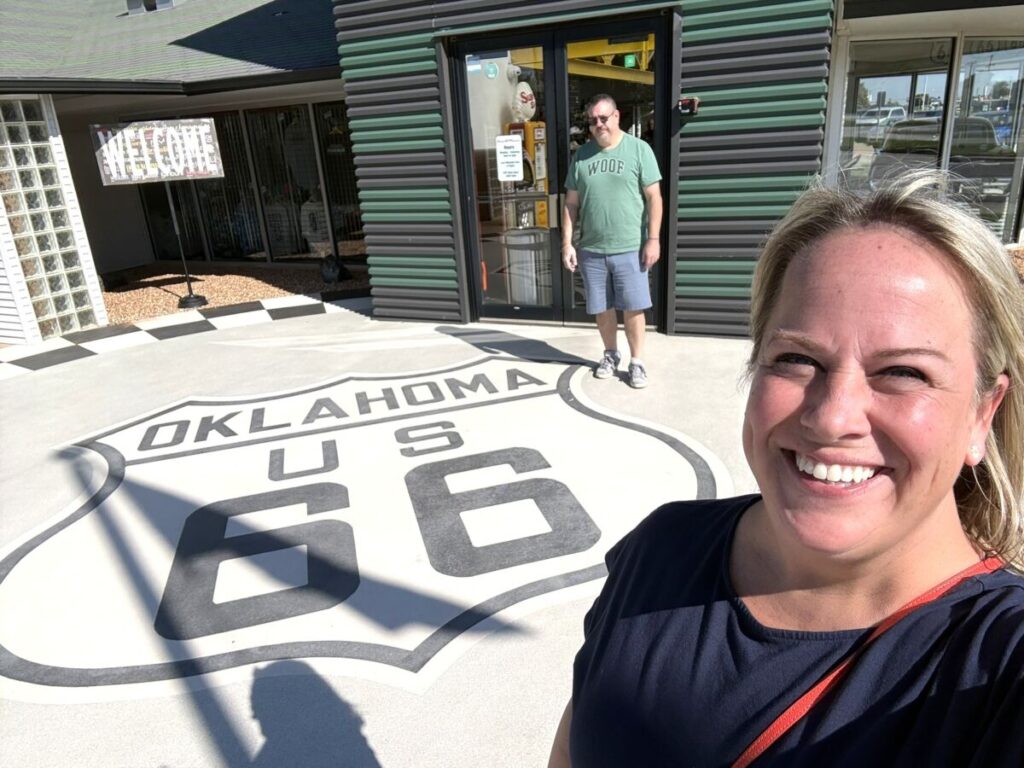
We had so much fun we vowed to complete the entire route together someday. But we didn’t want to miss the centennial celebration, either. Oklahoma boasts more drivable miles of Route 66 than any other state, with more than 400 miles to explore. We flew to Tulsa on a Friday and spent the weekend driving west through Oklahoma City to the Oklahoma Route 66 Museum in Clinton.
It was a whirlwind road trip filled with roadside oddities, small-town charm, history and plenty of reasons to pull over for one more photo.

TIP 1: Make the most of a short trip. Allegiant and Southwest offer nonstop flights from Central Florida to Oklahoma destinations, including Tulsa and Oklahoma City, depending on the airport and schedule. Non-stop flights can save valuable time on a short weekend getaway.

Tulsa: Where the Mother Road comes to life
Some consider Tulsa the capital of the Mother Road and it’s easy to see why. The city celebrates its Route 66 heritage with historic landmarks, oversized statues and new centennial attractions.
The East Meets West monument depicts a family traveling by automobile alongside a horse-drawn carriage. The horses react with alarm to the unfamiliar combustion engine, capturing a moment when modern transportation began changing the American landscape.
For the centennial, Tulsa introduced a musical road near the monument. Drive over the specially grooved pavement at the designated speed and it plays “This Land Is Your Land,” written by Oklahoma native Woody Guthrie.

Tulsa is also home to several Muffler Men, enormous fiberglass advertising statues created in the 1960s. Buck Atom the Space Cowboy, Stella Atom the Space Cowgirl, Meadow Gold Mack the Lumberjack, Cowboy Bob and Rosie the Riveter are among the city’s larger-than-life characters. Located in the Meadow Gold District, a lively area with restaurants, bars and shops, this is a must-stop.
TIP 2: Don’t let your GPS hijack your road trip. Navigation apps often direct drivers onto Interstate 44 when Route 66 runs nearby. Follow the historic highway signs and map your stops ahead of time. The two routes run close together in many places, making it easy to use the interstate when you’re short on time and return to Route 66 for the next attraction.

Small-town charm and Route 66 History
About 14 miles southwest of Tulsa, Sapulpa offers flower-lined streets, charming boutiques and quaint cafés. It may not have the headline-grabbing attractions found elsewhere, but it’s a pleasant place to slow down and explore.
From Sapulpa, it’s about a 40-minute drive to Stroud and the historic Rock Café. Featured on “Diners, Drive-Ins and Dives,” the restaurant is known for its original 1939 flat-top grill, Betsy. Its pop-culture connection is equally compelling: when Pixar’s creative team traveled Route 66 researching the 2006 film “Cars,” they spent hours talking with owner Dawn Welch. Her story of leaving the big city and working to keep her small-town restaurant alive helped inspire Sally, the Porsche character in the film.
About 14 miles farther west, the Route 66 Interpretive Center in Chandler offers an immersive introduction to the highway’s history. Visitors can experience different eras of road travel from the driver’s seat of a Model A Ford, a Willys Jeep and a Mustang. Vintage motel beds recreate the experience of resting at a classic roadside motel after a long day behind the wheel.

Soda bottles, round barns and neon cowboys
Continuing toward Oklahoma City, stop in Arcadia to see its historic Round Barn, built in 1898, and Pops 66. The barn’s distinctive circular design makes it a favorite for photographers, while Pops combines a restaurant and filling station with more than 700 soda varieties.
The biggest attraction is outside: a 66-foot soda-bottle sculpture that lights up after dark. If your schedule allows, visit in the evening to see it illuminate the highway.

In Oklahoma City, Kicks 66 celebrates the centennial with a 35-foot-tall red neon cowboy boot outside the National Cowboy & Western Heritage Museum. The installation features a Route 66 shield, musical notes, cactus sculptures and lyrics from Nat King Cole’s classic recording of “(Get Your Kicks on) Route 66”: “Oklahoma City looks mighty pretty.”
Oklahoma City also offers several worthwhile detours:
- Tower Theatre: This 1937 Art Deco landmark retains its classic auditorium and neon marquee.
- Milk Bottle Grocery: A tiny, triangular brick building topped by a giant milk bottle since 1948. Today, the bottle advertises Oklahoma-based Braum’s.
- Oklahoma State Capitol: Notable for its architecture and the oil wells that once operated on its grounds.
- Oklahoma City National Memorial & Museum: A moving tribute to those affected by the April 19, 1995, bombing.
- Cattlemen’s Steakhouse: Located in Stockyards City, this institution has served steaks since 1910. Adventurous diners can try lamb fries, a regional specialty made from lamb testicles. Our family thought they tasted like fried oysters!
El Reno: Home of the onion burger
About 30 minutes west of Oklahoma City, Route 66 passes through El Reno, famous for its Depression-era onion burger. Created when cooks stretched scarce ground beef by pressing thinly sliced onions directly into the patties, the burger has become an Oklahoma classic.
Sid’s Diner is a must for anyone wanting to try one. Be prepared to wait, but sampling this local specialty is worth the stop. Get a chocolate malt and know that an order of fries is enough for a family of four.

El Reno is also benefiting from Oklahoma’s Route 66 restoration efforts. Among the projects supported by centennial funding was the restoration of a 1930s Texaco gas station. Today, the building serves as a gift shop and information hub, with classic cars belonging to area residents displayed in its service bays on a rotating basis.
Finishing the journey in Clinton
Our Oklahoma adventure ended at the Oklahoma Route 66 Museum in Clinton. The exhibits trace the highway’s evolution, from its construction and role during the Dust Bowl to the golden age of postwar road trips. We experienced a recreation of the Dust Bowl, sat in a phone booth and settled into a 1950s-style diner. The interactive displays brought context to the quirky landmarks and small-town businesses we’d encountered along the way.
TIP 3: Get a Route 66 Passport. Similar to the National Parks Passport, this small booklet lets you collect stamps and stickers at quintessential stops to remember your travels. It is a small and very packable souvenir, a win-win.
We returned east on Interstate 40 toward Oklahoma City, then took Interstate 44 to Tulsa. In many places, the modern interstates run remarkably close to the old highway, sometimes just across a strip of grass. The two routes seem to trace parallel lines through the landscape: one built for speed and efficiency, the other carrying nearly a century of memories.
Route 66 is still doing what it has always done best: bringing people together through the simple act of traveling. The interstates may offer a faster way to reach the next destination, but the Mother Road reminds us that the detours, roadside oddities, small-town diners and unexpected discoveries are often the things we remember most.
As my family continues our journey toward completing all 2,448 miles, I’m glad we explored Oklahoma during this centennial year. The past and present may travel parallel paths, but on Route 66, the past is never far behind.