










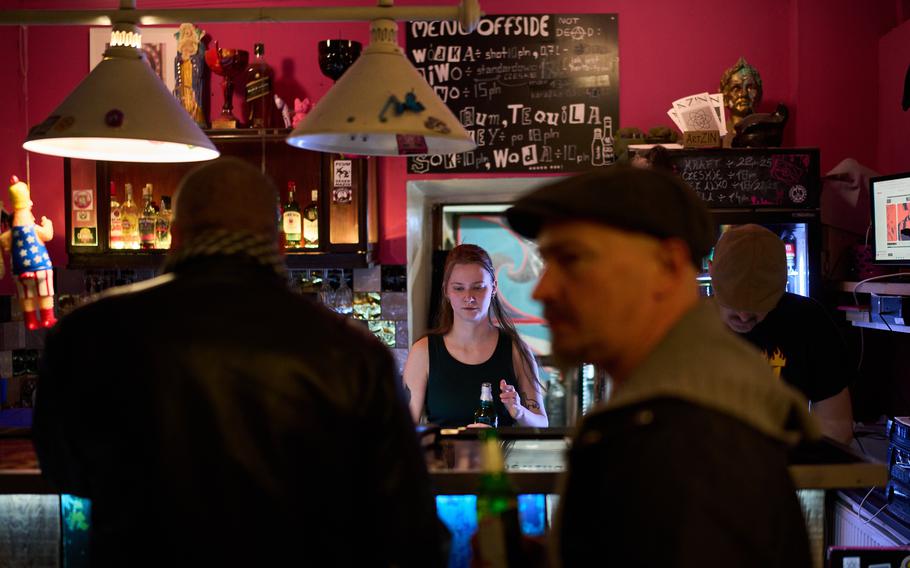

People enjoy their time at a bar on the weekend in Warsaw, Poland, on April 25, 2026. A new order signed by a V Corps leader prohibits U.S. soldiers permanently stationed in Poland from visiting bars, nightclubs and certain karaoke and hookah lounges. (Ebrahim Noroozi/AP)
U.S. soldiers permanently stationed in Poland are now prohibited from visiting bars, nightclubs and certain karaoke and hookah lounges during off-duty hours.
The tighter restrictions result from a revised V Corps general order that eliminates exemptions previously granted to troops stationed overseas.
The Nov. 5 order from V Corps commander Lt. Gen. Thomas Feltey extends long-standing prohibitions for permanently assigned soldiers, including those living in off-installation housing in Poznan, Poland.
“Our soldiers are in Europe for a purpose: to deter aggression and be ready to fight if called upon,” Feltey said in response to questions.
A June 2024 version of the order specifically exempted soldiers serving on permanent change of station orders from most restrictions on off-limits establishments. That exemption is absent from the updated policy, which took effect immediately.
Under the previous directive, restrictions on visiting bars, casinos, karaoke and hookah lounges and nightclubs did not apply to soldiers on PCS orders.
V Corps soldiers at Camp Kosciuszko in Poznan were informed of the updated restrictions during a formation Friday, according to four soldiers who spoke with Stars and Stripes.
One permanently assigned soldier who lives off base said the announcement caught personnel off guard and left them uncertain about how the new restrictions would affect their off-duty activities.
“Everybody was kind of shocked and kind of trying to figure out what they can and can’t do,” said the soldier, who spoke on condition of anonymity because of fears about possible retaliation.
The soldier, who previously served overseas and deployed, said the limitations make the permanent assignment feel more like a deployment than an opportunity to live abroad.
The order applies to soldiers in V Corps’ designated area of responsibility, which covers 16 countries, including Poland, Romania and the Baltic states.
The command estimates that more than 15,000 assigned, rotational and supporting personnel are subject to its provisions.
Lt. Col. Vincent Gothard, V Corps director of public affairs, said the policy is a proactive measure intended to strengthen discipline and readiness along NATO’s eastern flank rather than a response to any particular incident or increase in misconduct.
The order defines a prohibited bar as an establishment whose primary purpose is to serve alcohol and that does not provide tables and menus for seated dining.
Karaoke and hookah lounges are prohibited when they primarily serve alcohol and lack seated dining accommodations. Nightclubs are defined as establishments with significant space dedicated to dancing, a disc jockey and a primary purpose of serving alcohol.
Restaurants are not automatically prohibited simply because they serve alcohol or offer karaoke.
However, the aforementioned soldier who spoke with Stars and Stripes said the definitions have created confusion about which businesses remain permissible, particularly establishments that serve food but transition into nightlife venues later in the evening.
The soldier questioned whether troops would be required to leave an establishment when its kitchen closes, even if it had previously qualified as a restaurant.
A V Corps noncommissioned officer permanently assigned to Camp Kosciuszko said no explanation was provided at the formation for why the restrictions had changed.
The November order also changes several provisions governing alcohol consumption and overnight movement.
Under the 2024 policy, soldiers on orders exceeding 30 days were prohibited from drinking alcohol during their first 96 hours in the U.S. European Command area of responsibility. That requirement does not appear in the updated order.
The earlier policy also established a 0.15 blood alcohol concentration limit for permanently assigned soldiers. The November order specifically prohibits personnel on temporary change of station or temporary duty orders exceeding 30 days from drinking to the point of intoxication, defined as impairment or a blood alcohol concentration of 0.08.
Both versions prohibit alcohol consumption within eight hours of duty or operating a vehicle.
The updated order requires soldiers on temporary assignments exceeding 30 days to have an approved battle buddy when leaving an installation or forward operating site between 10 p.m. and 5 a.m., unless on approved leave or pass.
The previous order established a battle-buddy requirement between 10 p.m. and 6 a.m. for personnel subject to that provision.
Permanently assigned soldiers are not required to have battle buddies for routine local travel, Gothard said.
Other provisions address electronic cigarette purchases and use, alcohol possession at forward operating sites and a new prohibition against interfering with wild animals during official activities or while at forward operating sites, with limited exceptions.
Violations of the order’s prohibited activity provisions are punishable under Article 92 of the Uniform Code of Military Justice and may result in disciplinary or adverse administrative action.
Commanders are briefing soldiers and incorporating the updated requirements into in-processing procedures, Gothard said.