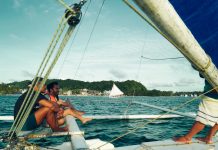







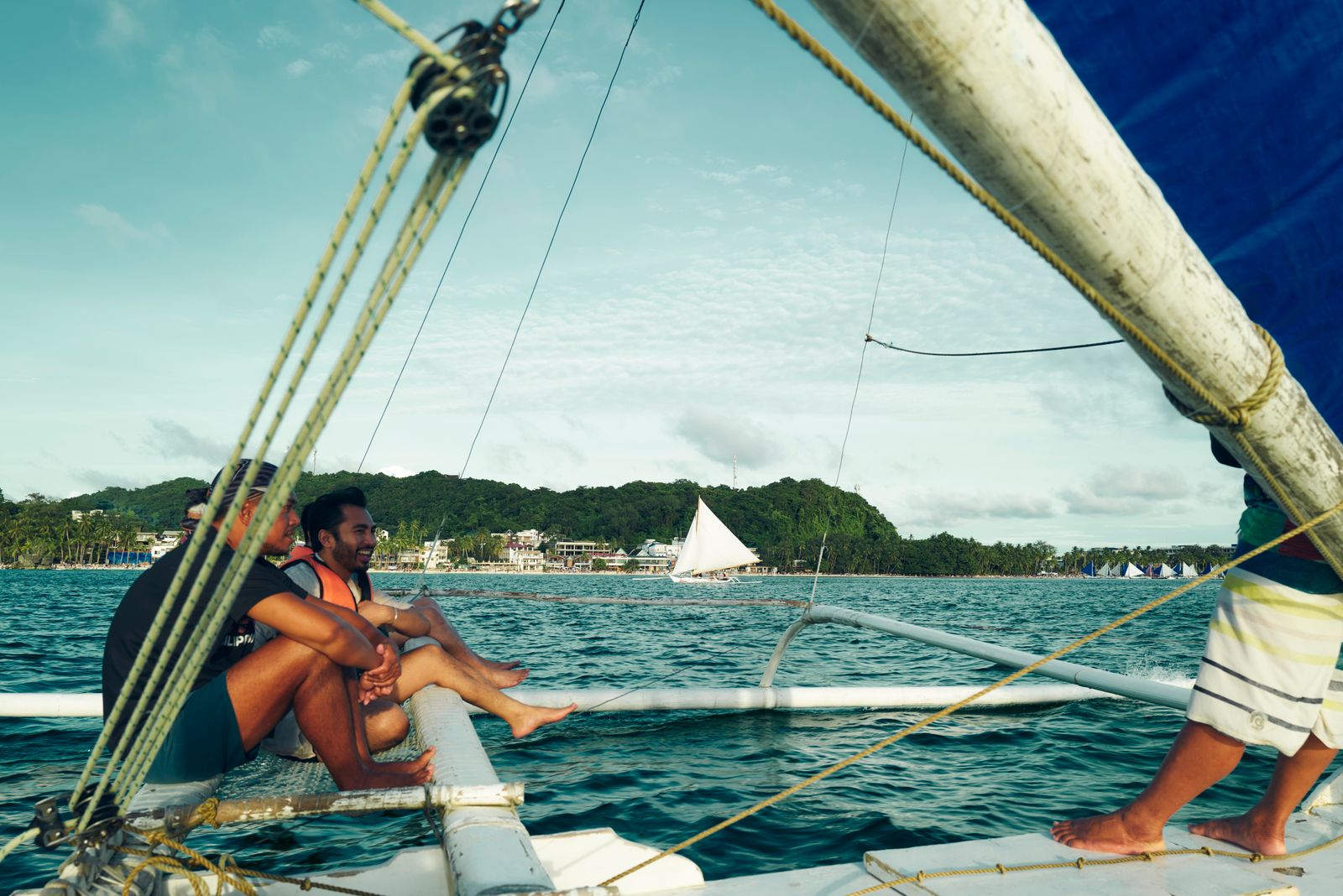
“Fun and sunshine, there’s enough for everyone,” says a neon sign before me at the discotheque Club Tropicana on Boracay, a four-square-mile island at the heart of the Philippines. The lyrics are from a buoyant 1983 song, also called “Club Tropicana,” by Wham!. But tonight’s playlist is cribbed from the 2010s. As midnight nears, Jennifer Lopez’s voice sounds over the speakers, “If you’re a party freak, then step on the floor.” So I twirl under a disco ball with gleeful strangers in bikini tops, cargo shorts, and Havaianas flip-flops, beers and gin and tonics in hand.
The effect is transportive. I’m flung 10 years into the past, back when Boracay was the locus of an exuberant, if at times debauched, nightlife scene on the creatively named White Beach. Crowds raved until sunrise and woke up on some of the world’s softest sand. They had budget hostels and three-star inns, 24-hour shops, water sports and boats, and eateries of all stripes to keep them entertained until nightfall. Then came the parties, VIP bottle service, and the voice of Kesha speak-singing over sound systems, “Tick-tock on the clock, but the party don’t stop, no.”
The thing is, it did. Boracay had to shed its hedonistic streak after a series of closures curtailed tourism. First there was the government-imposed cleanup in 2018 ordered by then president Rodrigo Duterte to correct rampant overdevelopment and environmental negligence. Then there was the COVID-19 shutdown from 2020 to 2022, when the Philippines was closed to foreigners. Boracay lost an estimated $845 million in tourism revenue in 2020 alone and counted only 260,000 visitors. Compare that with 2017, when it raked in roughly $1.1 billion by welcoming more than 2 million travelers who dug their toes into a White Beach clogged with the debris of multiday concerts and ragers thrown by local hosts and corporate mega-sponsors. Broken bottles, cigarette butts, and waste—plastic and otherwise—came in and out with the tides.

Despite growing up in Manila, about an hour away by plane, I never got to see “old” Boracay before immigrating to the United States in 2003. In the 1990s it was beloved for its rustic milieu and unfussy hospitality, though it was already a resort island with more than 100 hotels. My family knew it best in the ’80s, when backpackers from Europe and the US began to arrive after the German writer Jens Peters called it, in his 1978 guidebook to the Philippines, “paradise on Earth.” In those halcyon days, paradise had no electricity or potable water. Ice was brought in from the mainland to chill San Miguel Pale Pilsens in Coleman coolers. Even my stepfather, a reluctant traveler, fondly remembers the Boracay of yore: “Your mother and I had only the sea and the stars.”
Boracay is changing yet again. Since 2022 it has vowed to revitalize its economy without sacrificing its environment. Laws now enforce a maximum of 19,000 tourists per day. Smoking, alcohol, littering, single-use plastics, and parties directly on the beach are forbidden. Visitors are not permitted without reservations at accredited lodgings—no more sleeping overnight on the sand. No longer raw as it once was, neither an unspoiled Eden nor a profligate Sodom, this grown-up Boracay is what I’ve come to see for the first time. As I gaze at the stars above a pristine White Beach, I think, So far, so good.